COP27 concludes with a big breakthrough for the most vulnerable

Climate-induced loss and damage, situations where adaptation is inadequate or no longer an option, is a growing threat around the world, especially in vulnerable communities. Over 30 years ago small island states tried to bring this topic onto the UN climate agenda. At the end of the UN Climate summit in Egypt, COP27, we can finally celebrate that Parties have agreed to establish a fund and to mobilise support to address these losses and damages.

Mattias Söderberg, co-chair of the ACT Alliance Climate Justice group says: “ACT Alliance is very happy for this political breakthrough. Those most affected by climate change should no longer feel forgotten. The global community has acknowledged their needs and agreed to act.”

“We join all global south negotiators in celebrating the COP27 commitment to a loss and damage facility,” says Rudelmar Bueno de Faria, general secretary of ACT Alliance. “This is the result of their determined action over many years, supported by civil society and faith actors.”

However, there are few other results from the summit to applaud.  “As faith actors on the front lines, we see the impact of inaction on God’s creation,” says Bueno de Faria. “We know that urgent action is needed to address the impacts of climate change, which more and more affect the poorest and most vulnerable people, those who have done the least to contribute to climate change. It seems that Parties at COP do not understand or are oblivious to the urgency of the climate emergency.”

Mitigation

Report after report has been released showing that mitigation actions currently announced by the countries of the world are nowhere near ambitious enough to keep global temperature rise to 1.5C. Yet the level of ambition at COP27 to accelerate these efforts slowed rather than increased. ACT is especially missing a clear call for the phase-out of all fossil fuels and clear shift to 100% renewables, which is not too astonishing given the extremely high presence of fossil-fuel lobbyists in Sharm el Sheik.  

“It is not acceptable that the rights of Indigenous peoples and human rights have been sidelined in the new agreement on carbon markets,” says Dr. Marianna Leite of ACT Alliance. “Similarly, the back-and-forth on the need to ground solutions in international law and science was appalling. We need to move away from false solutions and call out parties which have been obstructing negotiations and pushing for clearly ineffective solutions such as the so-called ‘circular carbon economy’.”

Adaptation

COP26 in Glasgow laid the path for increased financial support to help communities adapt so they can better survive droughts, storms, and the changing climate. The proposed doubling of adaptation finance would help address the urgent needs of subsistence farmers, fisherfolk, and many other communities.

“It is inexcusable that a year after agreeing to double adaptation finance, that promise cannot be advanced at COP27,” says Kata Kuhnert, youth delegate from the Evangelical Lutheran Church in Canada. “Support to help vulnerable states and communities adapt to more frequent and extreme weather events impacted by climate change cannot wait.”

Gender, Indigenous and Human rights

The rights of women and girls, in all their diversity, as well as the rights of Indigenous peoples and human rights were often sidelined in negotiations. These rights are virtually invisible in the texts agreed upon related to climate finance, mitigation and adaptation. “An intersectional gender lens cannot be an afterthought,” says Manal Shehade, ACT Alliance MENA Gender Community of Practice Chair and COP27 delegate. “The truth is that without finance, there will be no gender transformative climate action and without gender justice there is no climate justice.”

Action that does not address the gendered dimensions of the climate emergency can further exacerbate inequalities. At COP27, we needed to see gender-inclusive policies being mainstreamed. Instead, we witnessed the watering down of language and further delays. The discussions on the Lima Gender Work Programme and its Gender Action Plan were expected to be deferred to Bonn in 2023, due to disagreement between Parties on the related support required. This resulted in a pause in negotiations, and then in the final hours, an ‘agreed’ text was ‘bulldozed’ through.

Finance

The report led by Canada and Germany showed that developed countries had only managed to mobilize USD 83bn per year, rather than the 100bn promised by 2020.  The expectation, that a clear plan for delivery of the shortfall so far and how to keep the promise in the upcoming years, would be established, was not met, only a vague call to meet the obligations remained. Efforts by parties to agree on which nations should be contributing funds to finance mitigation, adaptation and loss and damage work led to disagreement as historic emitters and middle-income countries with growing current emissions sparred over who should be included in the category of contributors.

There have been a number of pledges from states towards climate finance, but not at the scale needed to address the critical needs of communities and whether they are additional and new as requested – is questionable. In addition, there was little progress on climate finance, including adaptation and loss and damage finance. Without this finance, the Global South cannot adapt to the climate emergency and the debt situation will get worse.  

“At COP27, there has been a lot of political posing with no real change to the status quo or accountability for the wrongs of the past,” says Prof. Cornelia Füllkrug-Weitzel, ACT Alliance Ambassador for Climate Justice. “At the end of the day, if polluters do not commit new and additional finance to tackle the current crisis—without further increasing the debt burden of vulnerable countries — their commitments will be nothing but empty words and they dramatically leave countries alone with the damages they have causes and continue to cause. This is irresponsible and lacks solidarity, regardless of their lip service to it.”

Conclusion

Savanna Sullivan, Program Executive for Youth for the Lutheran World Federation says that “To secure a safe planet for future generations, we need bold decisions for climate justice from all. We need to involve youth in the discussions. Not only do they bring important ideas and perspectives to negotiations and conversations now, but they are also the ones who will be in the room forty years from now. The investment we saw at COP27 in youth leadership and participation is an investment in the future of our planet.”

“Delays in international cooperation mean a delay in action in communities, where people are losing their homes, livelihoods, and even their lives every day.  This cannot continue,” concludes Bueno de Faria.  “We must keep our eyes on 1.5C and the deep emission cuts needed to get there, and on ensuring that climate justice is at the heart of all the work of this and all COPs.” And, equally important, Bueno de Faria added – “developed countries need to immediately operationalise and, therefore, mobilise new and additional finance for the newly created loss and damage funds.”
Press release: Faith leaders urgently call for increased ambition in closing days of COP27

November 17, 2022

Sharm el-Sheikh, Egypt

Faith leaders from around the world at COP27 have watched with concern as the negotiations have stalled and not pushed for more ambition to prevent the drastic consequences predicted if global temperature rise goes past 1.5C, to support the most vulnerable communities and nations facing the brunt of climate change’s impacts today, and to ensure that human rights, a gender lens, and indigenous people’s knowledge are enshrined in the structures and work of the UNFCCC and its parties as they confront the climate emergency. 

Faith leaders have issued today an urgent call for increased ambition in the final days of COP27.

“While negotiations stall, people are dying and livelihoods are being lost as a result of the impact  of climate change,” the statement reads. “Time is running out and it is unacceptable if world leaders do not take clear and decisive action within the few remaining days of COP 27.”

The faith leaders, drawing on the call from the Interfaith Talanoa dialogue at the beginning of COP, the faith leaders are calling on leaders at COP27 to preserve all of God’s Creation by:

  • Recognizing the urgency of the crisis
  • Establishing a new funding facility for Loss and Damage
  • Richer countries meeting their commitment to $100bn annually for adaptation and mitigation
  • Wealthy countries canceling debt, provide adequate new finance, and a L&D facility
  • Ensuring gender is not siloed but a clear gender transformative climate action lens be applied in all climate work 

XXXX

Media contact:
Simon Chambers, WhatsApp +1-416-435-0972

A phase out of fossil fuels must be combined with scaled up climate finance for a just transition

All around the world, people are marching, they are chanting, advocating, demanding that world leaders do what it takes to Keep 1.5 alive. Negotiators at COP27 must heed those demands. 

ACT Alliance, a global network of 147 churches and agencies doing humanitarian response, development and advocacy work in over 125 countries, is on the front lines of vulnerable communities who have done the least to cause climate change yet face the worst of its impacts. 

“Even with global temperature rise at 1.2, the world is seeing more frequent and severe climate-induced disasters- droughts, storms, and more,” says Rudelmar Bueno de Faria, general secretary of ACT Alliance. “ACT members support communities in preparing for, surviving, and recovering from such events.  We know the challenges.  And the need of local communities.”

And the world needs action.  Now.  To make sure global temperature will not increase above 1.5C.

“A climate summit that gives up on 1.5 will be a failure,” says Mattias Söderberg, chair of the ACT climate justice group. “Just seven years ago in Paris, we committed to strive for 1.5.  But each year we delay, we stall, we avoid, and the time horizon for urgent action shrinks each day.”

A big step towards achieving 1.5 would be to keep fossil fuels in the ground.  While we desire a phase out of fossil fuels, ACT supports the reality at COP27 as  some parties rally behind the idea of “phasing down all fossil fuels.” A phase down is one  step closer to what is needed- phasing out fossil fuels and transitioning to renewables, but Söderberg notes,””Such a phase down will not be possible without commitments from developed countries to support developing ones to phase down fossil fuels.“

Many countries depend on income from fossil fuels, and a transition away from fossil fuels will thus have big impact on the economies.Global transformations are needed to keep 1.5 alive. Phasing down- and ideally phasing  out-  fossil fuels to keep 1.5 alive must be complimented by adequate finance commitments to support just transition in developing countries. 

Bueno de Faria concludes, “We would like to see a COP27 outcome including commitment to the phase out of all fossil fuels.  It should be accompanied by an equal commitment from developed nations to mobilise the needed finance to make it possible.  This will be a big step towards keeping 1.5 alive, and meeting the needs of the most vulnerable, including women and girls, who daily face the consequences of inaction on climate change.”

XXXX

Media contact:
Simon Chambers WhatsApp: +1-416-435-0972 simon.chambers@actalliance.org

Call from voices of faith around the world to COP27

15 November 2022

FOR IMMEDIATE RELEASE

MEDIA ADVISORY

Call from voices of faith around the world to COP27

People of faith present at COP27 and around the world joined together on November 6 for a Talanoa dialogue, discussing a variety of aspects of climate justice and their call for progress in the negotiations at COP27. Representatives of faith groups, including youth, indigenous, and voices from around the world, will share key aspects of the Talanoa. Participants at COP from faith backgrounds bring the experiences of communities on the front lines of the climate emergency, they bring a moral dimension to the debate, and they also bring technical expertise through their engagement in combatting climate change and in climate justice advocacy

84% of the world’s population ascribe to a faith tradition, and faith communities are part of all communities in the world.  They work as part of these communities together with local leaders and communities to address the impacts of climate change.  The Interfaith Liaison Committee brings together faith constituencies working to achieve climate justice to raise their voices together and share their stories from their traditions and experiences around the world.

What: People of faith representing a range of faith traditions, countries, ages, and gender share calls from the 100+ people of faith who took part in the Talanoa dialogue on Nov 6, 2022 in Sharm el-Sheikh.

Who: Rt. Rev. Marc Andrus, Bishop of the Episcopal Diocese of California (USA)
Ms. Maureen Goodman, Brahma Kumaris representative to the United Nations (UK)
Ms. Kata Kuhnert, Lutheran youth (Canada)
Imam  Saffet Abid Catovic, ISNA Office for Interfaith and Community Alliance and Government Relations (USA)

Rev. Henrik Grape, Senior advisor on Care for Creation, Sustainability, and Climate Justice for the World Council of Churches – Moderator

Where: Press conference room (Luxor) and online

 When: Tuesday, November 15, 2022 16h30-17h00

Why: Faith communities bring concrete experiences of the impact of climate change on the most vulnerable people, including women and girls in all their diversity and people on the move, who have done the least to cause climate change and are facing the brunt of its impacts. Faith groups are on the front lines, responding to climate change through mitigation, disaster risk reduction, adaptation, and more.

# # # # #

MEDIA CONTACT
Simon Chambers +1-416-435-0972, simon.chambers@actalliance.org
Head of Communications, ACT Alliance

Press release: Launch of the Multi-Faith/Multi-Sector Alliance for Climate Action (MFSA) at COP27

November 15, 2022

Launch: the Multi-Faith/Multi-Sector Alliance for Climate Action (MFSA). 

Please join us for the formal launch of an innovative new alliance, the Multi-Faith/Multi-Sector Alliance for Climate Action (MFSA). 

The alliance will be a neutral bridge between existing multi-faith actors and their coalitions, and key secular actors (including governments, multilateral organizations, the private sector, civil society organizations, and media).

When: Wednesday, November 16 14h00 (Cairo time)

Where: IFRC Pavilion- Blue zone (beside UNFCCC and Egypt Pavilion) COP27, Sharm el Sheikh, Egypt.  Online on Youtube: Multi-faith/Multisector Alliance for Climate Action at COP27 

Refreshments.

Interviews can be made available with:

  • Rudelmar Bueno de Faria, General Secretary, ACT Alliance

MEDIA CONTACT: Simon Chambers, ACT Alliance, WhatsApp: +1-416-435-0972 or simon.chambers@actalliance.org

A long way to go at COP27

COP27 has reached its halfway point, and there is a long way to go if this conference is to conclude with strong steps forward for climate justice.

“We must not get distracted by technical and procedural discussions,” said Rudelmar Bueno de Faria. “The parties must keep the needs of the most vulnerable people, including women and girls in all their diversity, indigenous people, and those in developing nations, at the forefront of their negotiations, and the decisions of this COP must provide the finance, voice, and seats at the table for them.”

ACT Alliance is a faith-based organization, and like all faith groups, ACT’s members are present in communities before, during and after disasters, including climate-induced ones.  “Churches and other communities of faith are best placed to know the situation and to be first responders,” said Mattias Soderberg, co-chair of ACT Alliance’s Climate Working Group. “As integral parts of the communities where we work, we know that all people are part of their communities, including youth, women, and indigenous people. Climate resilience requires communities too, and those communities must include the voices of all.”

ACT Alliance notes that there is not enough progress in many workstreams. 

Mitigation- keep your eye on the prize

 A strong, climate justice focused result on mitigation must keep focused on the need to limit global temperature rise to 1.5C.  To achieve this, we must think outside the box, looking at economy-wide emissions cuts, nature-based solutions, locally led processes, and other innovative methods as work to enhance mitigation ambition. We must not allow backtracking of progress so far to keep 1.5 alive, but ensure we keep the bar within reach.

Article 6- human rights at the centre

 Human rights, gender responsive text, and the inclusion of indigenous peoples in the processes are necessary to a good result on Article 6.  In addition, mechanisms must be transparent and clear, avoiding double counting or inclusion of false solutions.

Gender- a weak tea so far

 The text on gender is weak language to date.  States are “encouraged” rather than “urged,”, and the strongest commitments are listed as “voluntary.”  The language must be stronger! It is important that finance is availed to strengthen gender responsiveness in climate action.

“Women and girls did not volunteer to be more impacted by climate emergencies. We want to see their involvement in all levels of leadership and decision-making processes for climate actions”, said Margareta Koltai, policy adviser from Act Church of Sweden.

Adaptation- missing in inaction?

 COP27 was touted as an adaptation and implementation COP, but there has been very little movement on either topic.  The decision to double adaptation funding made at COP26 in Glasgow is a good one, but the question remains of who is benefiting from the funds.  We need good quality adaptation finance flows, with grants rather than loans, and where funds reach the people who need them most: the vulnerable people who have done the least to cause climate change yet face the worst of its impacts.

Finance- 17 billion short and counting

 While we applaud the decision to double adaptation finance, we underscore the importance of funding being new and additional, not being drawn from other incredibly important work, including humanitarian response and ODA.  We call on developed nations to meet their commitment to 100 billion dollars per year, not the 83 billion that Canada and Germany reported in week 1. And we know that the majority of  these billions are loans that much be paid back, and most of the funds are taken from existing aid budgets, leaving less funds for projects supporting education, healthcare and democracy.

“We know that the needs for adaptation and loss and damage will continue to grow, and that 100 billion is not nearly enough,” said Cornelia Füllkrug-Weitzel, Special Envoy for Climate Change of ACT Alliance. “People and communities are impacted by climate induced disasters every day, and support must be available to communities to adapt and recover.”

Loss and Damage- stepping stones to a solution

ACT is pleased that loss and damage was included in the agenda for COP27, but having it on the agenda is not enough.  COP27 must agree to the need for loss and damage finance- new and additional financing, in the form of grants, not loans Once COP27 agrees to the need for finance, work can continue towards COP28.

From deliberation to action

“As we start the second week, we remind our political leadership that we are at a tipping point,” said Julius Mbatia, global climate justice program manager at ACT Alliance. This year’s global climate talks must set decisions that facilitate implementation to secure our planet and the lives of those vulnerable to climate impacts. We need no more failed commitments, shifting blame and burden. It is time we repurpose this process from deliberations to action.”

Media contact

Simon Chambers WhatsApp: +1-416-435-0972 simon.chambers@actalliance.org

Gender skit at COP27: building a pyramid of images

November 14, 2022

Gender skit at COP27: building a pyramid of images

Join ACT Alliance, Christian Aid and members of other faith-based organisations for a skit with visuals that will show the need for increased gender responsiveness in the negotiations.  Images and stories of women from around the world will be shared, and then used to build a pyramid over a banner calling for gender justice in climate justice.

The stunt will highlight the reality that women and girls are more impacted by climate change, and underscore the need for climate justice to involve the equal participation of women and girls in all their diversity.

When: Monday, November 14 15h30 (Cairo time)

Where: In front of the monolith between the zones

Interviews can be made available with 

  • Rudelmar Bueno de Faria, General Secretary, ACT Alliance
  • Mariana Paoli, Global Advocacy Lead, Christian Aid

MEDIA CONTACT: Simon Chambers, ACT Alliance, WhatsApp: +1-416-435-0972 or simon.chambers@actalliance.org

Press release: Climate finance skit at COP27- Detectives hunting for climate finance  

Press release: Climate finance skit at COP27: Detectives hunting for climate finance 

November 9, 2022

Climate finance skit at COP27: Detectives hunting for climate finance  

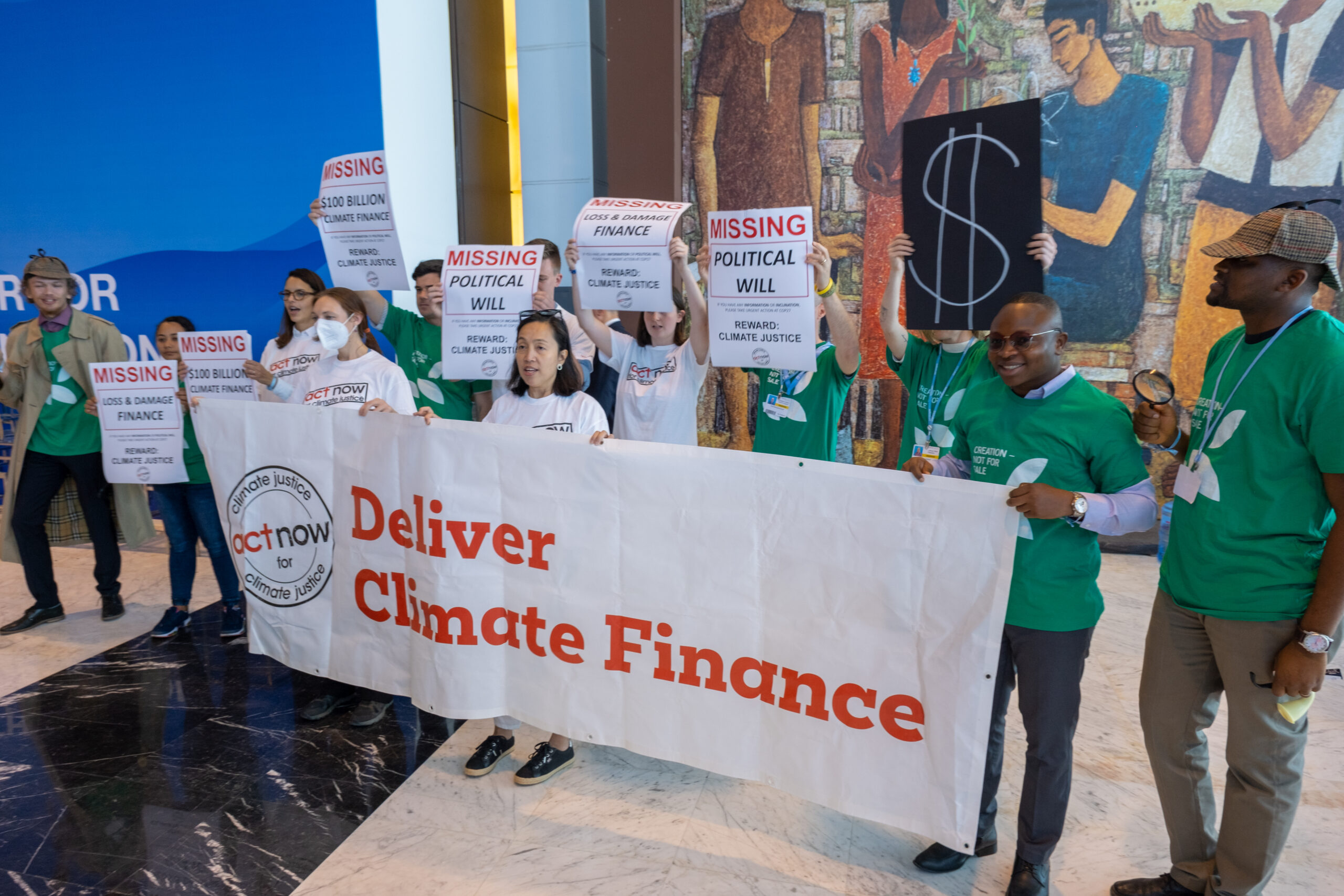
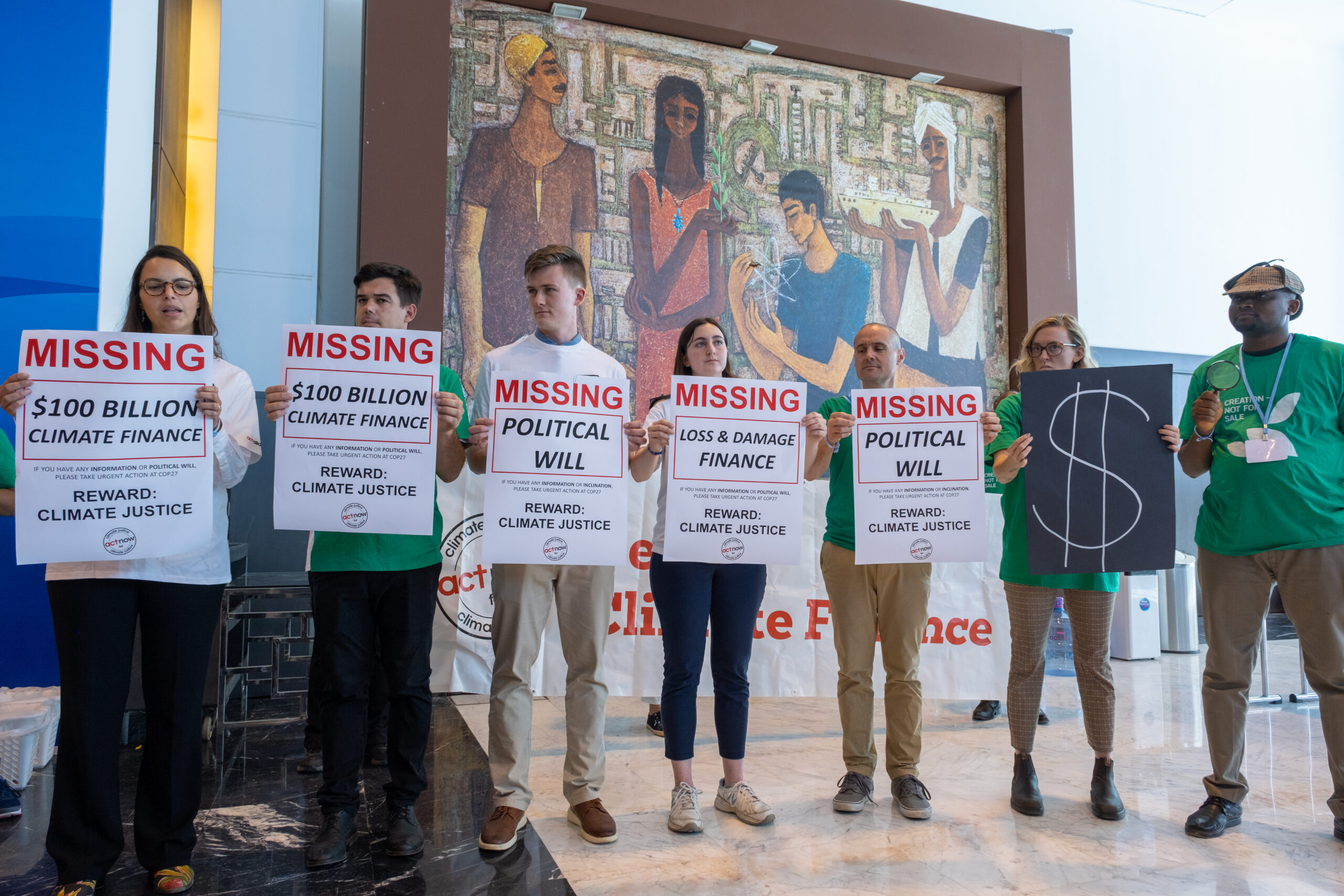
Join ACT Alliance, Christian Aid and members of other faith-based organisations for a skit with visuals that will show detectives hunting for the missing climate finance, following up on missing issues including “Loss and Damage”, “Gender justice”, and “Political will”.  The reward for returning them to the negotiations?  Climate justice!  

The action will illustrate the need for new and additional finance to reach the $100bn that has not yet been achieved, and the funds needed to meet the actual needs of vulnerable states and communities for adaptation, loss and damage, to survive the impacts of climate change that they have done so little to contribute to.  

When: Thursday, Nov 10 at 13h00 (Cairo time) 

Where: In front of plenary room 2 (Ramses) 

Interviews can be made available with:  

  • Cornelia Füllkrug-Weitzel, Special Envoy for Climate Justice ACT Alliance  
  • Mariana Paoli, Global Advocacy Lead, Christian Aid

MEDIA CONTACT: Simon Chambers, ACT Alliance, WhatsApp: +1-416-435-0972 or simon.chambers@actalliance.org 

ACT Alliance concerned about the negative effects of cuts in development assistance to Global Health [Press release WHA75]

The World Health Organisation opened the 75th World Health Assembly yesterday on Sunday, the 22nd of May, 2022.  

Tomorrow, the Assembly will discuss WHO’s work in health emergencies and the plans to improve pandemic preparedness.

Four regions are currently experiencing a rise in Covid-19 cases, and the number of deaths is on the rise in Africa. The pandemic is not over, while the attention and the funding seem to be fading. 

Governments in Europe are cutting their aid budgets including funding for global health. While the WHO is calling for adequate resources from States to meet its crucial mandate, some traditionally key donors are channelling less than expected funding into its structure, and other global health initiatives.

The update submitted to the assembly from the Independent Panel for Pandemic Preparedness is worrying. They argue that progress is slow and, in their words, at the present pace “the world is laying the groundwork for failure and the risk of a new pandemic with the same devastating consequences”.

“If confirmed, these budget cuts are worrisome especially at a time when we should redouble our efforts to prevent future pandemics, not reduce them. The humanitarian impact of outbreaks like the COVID-19 has a negative effect not only on community and global health but also on justice and human rights. I trust that governments will reconsider these myopic cuts and work collectively to strengthen and support WHO’s work”, says the General Secretary of the ACT Alliance Rudelmar Bueno de Faria.

“Now is the time to build WHO stronger, not to weaken this important tool for pandemic preparedness”, says Dagfinn Høybråten, General Secretary of Norwegian Church Aid, a member organisation of the ACT Alliance.

“We are concerned of the overall cuts to development aid, including cuts to important global health work such as the Global Fund as seen in Sweden. Even before the COVID-19 pandemic struck, the world was not on track to reach the SDG 3 on health and wellbeing. A strong and ongoing investment in global health is crucial to build back better from the pandemic.” says Erik Lysen, moderator of the ACT Alliance and Director of Act Church of Sweden.

For media enquiries please contact: 

Daniela Varano, ACT Alliance, daniela.varano@actalliance.org or

Dr Marianna Leite, Global Advocacy and Development Policy Manager, ACT Alliance, marianna.leite@actalliance.org

ACT Alliance is a global network of religious organisations and churches operating in more than 145 countries worldwide working on humanitarian relief, migration and displacement, climate and gender justice.

Local churches are frontline response for 10 million displaced Ukrainians

Joint media briefing ACT Alliance and World Council of Churches

During a 22 March press briefing, a delegation from the World Council of Churches (WCC) and ACT Alliance shared their observations from a recent trip to Hungary, Romania and Ukraine, where they witnessed firsthand both urgent humanitarian needs and a robust church response.

“You see the consequences of war which is forcing millions of people to leave their land,” said Rudelmar Bueno de Faria, ACT Alliance general secretary, noting the heightened risk for human trafficking and forced labor.

“We heard from ACT members and from church workers that the first wave of refugees were mainly people with healthy financial situations and good connections in Europe,” he said, while a second wave comprised people with fewer resources.

“The third wave we are facing now is of people without any resources,” he said. “During the visit we could see the distinctive role that church and faith-based organizations played in the emergency response so far.”

Prof. Dr Isabel Apawo Phiri, WCC deputy general secretary, said that the reason church response is able to happen is because many churches are well-equipped structurally to quickly turn compassion into actions that address human need, wherever it occurs.

“When in Hungary and in Romania, we heard the churches telling us that they were among the first ones to respond to the crisis at the borders,” she said. “For me, it’s not so much the churches responding to this particular issue—it’s because they already have structures in the churches to respond to any humanitarian need.”

Those structures have been used with a sense of caring and mission by churches that have responded, for example, to COVID-19 and other disasters, she added. “They are using the same structures to respond now to the humanitarian needs of the refugees coming out of Ukraine.”

Peter Prove, WCC director of international affairs, commented on the large dimension of this humanitarian catastrophe. “I think the latest figures we have heard from UN sources are something approaching 10 million people are displaced as a result of this conflict, both refugees crossing the borders into other countries, and internally displaced within Ukraine.”

That amounts to one quarter of the population of Ukraine, he said. “That really sets the dimensions of this crisis in perspective,” he said.

Prove took a moment to celebrate the response of local churches. “This welcome, organized at the local level by local communities and local churches, is incredibly warm and incredibly hospitable, and that is very much to be celebrated,” he said.

All three speakers emphasized the need for the same level of hospitality and care for people of color and others who are not receiving equal consideration as they, too, flee Ukraine.

The press briefing was moderated by Simon Chambers, director of communication ACT Alliance and Marianne Ejdersten, WCC director of communication.

This story was also published on:  https://www.oikoumene.org/news/local-churches-are-frontline-response-for-10-million-displaced-ukrainians-shares-wcc-and-act-alliance