Co-authored by,
Takeshi Komino, Krity Sneha, Henna Hejazi, Katherine Braun and Bijaya Bajracharya.
For communities in Nepal, climate change is no longer a distant risk. Floods, glacial retreat and increasingly severe climate-related hazards are destroying homes, infrastructure and livelihoods, and taking lives.
The recent floods have raised urgent questions about whether climate ambition, adaptation finance and early warning systems are keeping pace with the risks communities face. They have also exposed the limits of adaptation when hazards exceed what existing systems are designed to anticipate and manage.
Faith actors and local organisations are often among the first to respond and the last to leave. But local solidarity cannot substitute for adequate national and international support to address loss and damage.
As COP31 opens in Antalya, the experience of Rasuwa and Nuwakot offers an urgent reminder of the widening gap between the climate risks communities face and the risks existing systems are designed and financed to manage. It is a gap that must be addressed through stronger climate ambition, accessible adaptation finance and effective support for loss and damage.
Fragile recovery: Living with the fear of another disaster
For families who survived the devastating Bhotekoshi floods, recovery was meant to mark the beginning of a return to normal life. Instead, renewed heavy rainfall associated with Cyclone Arnav brought fresh anxiety to communities already struggling with the loss of homes, livelihoods and belongings.
During the rainy week of 24 – 28 September, heavy rainfall caused water to seep through temporary shelter roofs, forcing families to move their bedding, clothing and the few possessions they had managed to save. Parents remained alert to leaks and changing weather conditions, while children woke as rain entered the shelters. For many households, every downpour brought the possibility of another flood, landslide or displacement.
The flood took everything we had. Now, every time it rains, we are afraid again. We keep wondering if we will lose what little remains,
The rainfall also slowed recovery. Flood-damaged roads could not be repaired as planned, landslides disrupted transport routes, and humanitarian assistance was delayed. Families who were already struggling to meet their immediate needs were left waiting longer for support.
The emotional toll is equally severe. The disaster has taken away not only homes and livelihoods, but also people’s sense of security. Parents are struggling to reassure children who fear the floods will return, while older people remain anxious about another emergency.
A young community leader whom Takeshi met at a holding centre in Nuwakot described how quickly lives can change. The centre was hosting 42 households, comprising 144 people evacuated from Rasuwa, including families from Khalte. On the morning of 26 August, he was walking towards the police station when he turned and saw the approaching wave. He estimates that he had less than two minutes to react. He ran uphill and then helped pull several other people to safety.
He survived because he made a quick decision and because there was a slope he could climb. He received no warning.
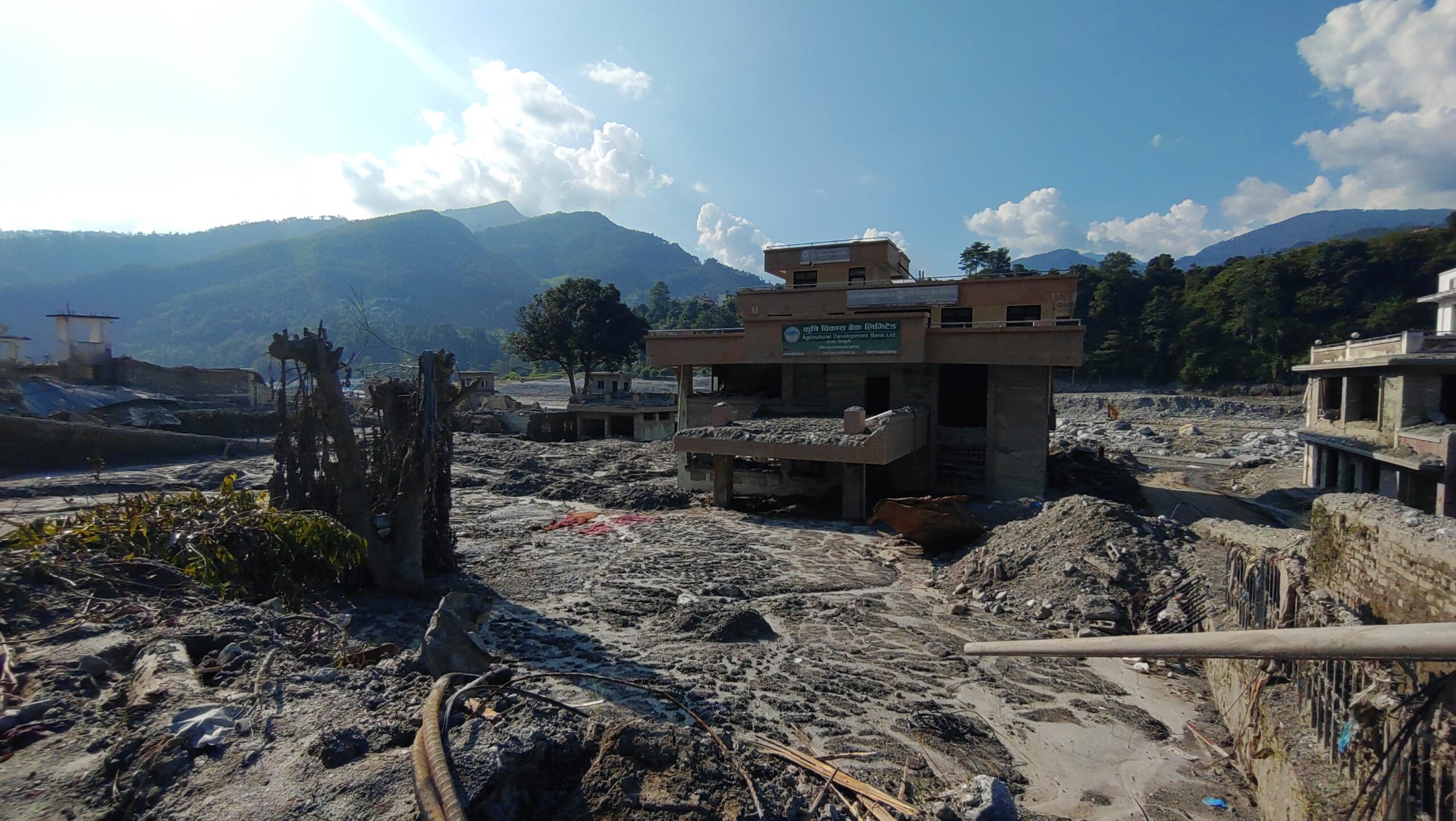
Khalte offers another important lesson. The settlement was established after the 2015 earthquake, when families whose homes had been destroyed were relocated there temporarily. But permanent reconstruction did not materialise, the land needed for resettlement was not secured, and river setback rules were not enforced. Over time, a temporary settlement became a permanent village beside a river. On 26 August, it was washed away.
Khalte illustrates the consequences of incomplete recovery: people displaced by one disaster remained exposed to the risks of another. It raises a difficult question: what does recovery mean if people are left in places where their safety cannot be guaranteed?
When the nature of climate hazards changes
The floods also reveal a challenge beyond the increasing severity of extreme weather. The nature of the hazards themselves is changing, while many systems used to assess and prepare for them remain based on historical risk patterns.
On the morning of 26 August 2026, a mass of ice and bedrock failed on the northern face of the Langtang Lirung massif, near the Nepal – China border. The collapse briefly dammed the Lhende Khola, a tributary of the Bhote Koshi. The dam burst within minutes, sending a powerful flow of water and debris downstream and affecting communities and infrastructure across seven districts.
The scale of destruction was extraordinary. In Nuwakot, sediment buried buildings and infrastructure, in some places reaching depths of 10 to 15 metres. The river channel widened significantly, reshaping parts of the valley. Local people described the event as a mountain tsunami.
Crucially, none of Nepal’s 47 catalogued potentially dangerous glacial lakes was involved. The event was triggered by a deep-seated slope failure involving ice and bedrock, rather than the outburst of a monitored glacial lake. This matters because existing monitoring and early warning systems are often designed around known hazards and established risk categories.
As temperatures rise, glaciers thin and lose their ability to support surrounding rock faces. Meltwater can penetrate fractures in the bedrock, weakening the structures holding ice and rock together. These processes can contribute to slope failures in areas that may not appear on existing hazard inventories.
According to information shared by colleagues working in the region, even institutions monitoring mountain hazards, including ICIMOD, recognised that this event fell outside existing risk categories. Identifying and monitoring similar risks across the Himalayan and Hindu Kush mountain ranges remains a major challenge.
Nor is this an isolated event. The region has experienced a series of destructive incidents, including a glacial lake outburst in 2016, an ice-rock avalanche in 2024, a supraglacial lake outburst in July 2025 and the August 2026 disaster.
The implications extend beyond Nepal. Communities in Pakistan, Afghanistan, India, Bhutan, China and Myanmar face risks associated with the same mountain systems. Rivers originating in these mountains also support communities and economies far downstream.
The challenge is therefore not simply to strengthen existing adaptation systems, but to ensure they can account for hazards that are changing in nature and may not yet be adequately mapped or understood. When a disaster exceeds the risks that existing adaptation systems can anticipate and manage, the question of loss and damage becomes unavoidable.
Displacement: When returning home is no longer possible
The consequences of the floods extend beyond the immediate loss of life and property. For thousands of people, the disaster has also meant displacement and uncertainty about where they can safely rebuild their lives.
More than 1,100 people were still living in displacement centres in late September. This figure captures only those staying in the centres. Others have sought shelter with relatives or neighbours, moved elsewhere or are struggling to find a safe place to stay.
In the Himalayas, climate-related disasters can have cascading impacts across borders and communities. Where poverty, insecure land tenure and limited social protection already exist, displacement can become prolonged. Families may be unable to return home, while others are pushed towards precarious urban settlements or, in some cases, across borders.
These risks are not experienced equally. Women, children, Indigenous communities and persons with disabilities may face additional barriers to accessing assistance, securing shelter and restoring their livelihoods.
An assessment conducted by Lutheran World Federation (LWF) Nepal on 28 – 29 August 2026 in several wards of Bidur Municipality, Nuwakot, highlighted particular concerns about the situation of displaced women and girls. Consultations with affected households, community leaders, government representatives and local disaster response structures identified growing protection risks associated with displacement and insecure living conditions.
Some vulnerable women and girls were moving towards Kathmandu without clear plans, secure accommodation or established support networks. Young mothers interviewed at a holding centre expressed uncertainty about where they would go once the centre closed. Some said they trusted their neighbours and intended to follow them to Kathmandu.
The scale of disaster displacement is also reflected in global trends. According to the Internal Displacement Monitoring Centre, disasters triggered a record 45.8 million new internal displacements worldwide in 2024, with South Asia among the most affected regions. These figures, driven largely by sudden-onset events such as floods and storms, do not fully capture displacement linked to slow-onset processes such as drought, glacier melt and sea-level rise.
The World Bank has projected that South Asia could experience up to 35.7 million internal climate migrants by 2050 under a high-emissions scenario without targeted action.
For Nepal, the immediate priority is to ensure that recovery does not move people from one vulnerable situation to another. Adaptation finance must support measures that help avert and minimise displacement, including early warning systems, resilient infrastructure, water security and livelihood diversification. Where displacement cannot be avoided, loss and damage finance must help communities address its consequences, including relocation and the restoration of livelihoods.
Early warning systems: Reaching people in time to act
Nepal has invested in early warning systems. Yet the August disaster exposed critical gaps between having a system in place and ensuring that people receive timely, accurate and actionable information.
From the collapse in the mountains to the arrival of the first wave at the border checkpoint, there were approximately seven minutes. At the Chilime Hydropower Company, the water arrived at 08:55, while warning messages reached staff at 09:00 and again at 09:38. The company lost six staff members, while a sister company lost 53. The warning arrived after the disaster had already struck.
The upstream river gauges did not simply fail to transmit information. They were destroyed by the event before reaching their alert thresholds. The first automatic threshold exceedance was recorded around three hours later, far downstream. The official alert was triggered by a district officer who raised the alarm by telephone at around 09:00. In this instance, the warning that saved lives was a phone call.
Downstream communities had more than two hours of lead time, yet people still died. One problem was the content of the warning. Messages indicated that a flood was coming but did not communicate its likely magnitude. After years of near-misses, a warning without sufficient detail may not prompt people to evacuate immediately. Some reportedly returned to retrieve cash or livestock.
In the worst-affected wards, the problem was even more fundamental. LWF Nepal’s assessment found that 90 per cent of the households interviewed received either no warning or only partial warning. None of the respondents could confirm the existence of a designated safe evacuation area.
Upstream, the challenge was different. The collapse occurred inside Chinese territory, where Nepal’s hydrology department has no capacity for direct on-site assessment. Despite previous events originating in the same border area, there remains a need for stronger cross-border procedures for sharing information and issuing warnings.
The disaster has also left the affected corridor more exposed to future risks. Many gauges along the Bhote Koshi and Trishuli were destroyed, weakening the area’s capacity to detect and warn against subsequent events.
Discussions with Nepalese members, ICIMOD and the affected hydropower company point to several areas for action:
- Detecting hazards at their source: Seismic sensors and infrasound monitoring could help detect large slope collapses within seconds, rather than relying solely on river gauges.
- Automate alerts: Alerts need to be triggered rapidly, without multiple human decision points that consume valuable time.
- Create safe evacuation routes: Communities need clearly identified routes to higher ground and accessible evacuation areas. A warning is of little value if people have nowhere safe to go.
- Strengthen cross-border monitoring: Satellite-based monitoring, including InSAR detection of slow slope deformation, could help identify risks in areas where direct access is difficult. This requires stronger regional cooperation and agreements on data exchange.
- Explore complementary technologies: Wire sensors installed across torrents can trigger alarms when broken by fast-moving debris or water. Their effectiveness, however, depends on regular maintenance, which must be included in local disaster management budgets.
Nepal’s rollout of the Early Warnings for All initiative, supported by a roadmap and cost budget developed with national stakeholders, offers an important opportunity. But the August disaster shows why the system must account for more than conventional hydrometeorological hazards. Cryospheric hazards and sudden slope failures also need to be recognised, monitored and financed.
Ultimately, early warning systems must be judged not by the number of people nominally covered, but by whether people receive information in time, understand the scale of the threat and have a safe route to act.
Who pays for climate impacts?
Nepal’s recovery needs are currently estimated at approximately USD 4.7 billion, with around half of that amount associated with hydropower. More than 400 megawatts of operating capacity were lost from the national grid, with the figure approaching twice that amount when projects under construction are included.
A significant part of the recovery effort therefore involves rebuilding the country’s energy infrastructure, alongside homes, livelihoods and essential services. This represents an enormous financial burden for a country that has contributed relatively little to the emissions driving climate change.
Colleagues and government counterparts in Nepal have emphasised the need for grants rather than loans. Countries should not be expected to take on additional debt to rebuild what climate impacts have destroyed.
There may be different financing approaches for different types of recovery. Hydropower infrastructure generates revenue, and concessional lending may be appropriate for some reconstruction investments, provided that monitoring and protection systems are built into those assets. However, people, land and risk information do not generate revenue. These public goods must be supported through grant-based finance.
There is also an opportunity to connect investments in infrastructure protection with community safety. Monitoring systems designed to protect hydropower facilities and their workers can also trigger warnings for downstream communities. Funding these systems separately risks duplication and missed opportunities for more integrated protection.
The wider lesson is that climate finance must be accessible, timely and responsive to the needs of affected communities. It must support not only the reconstruction of physical assets, but also relocation, livelihoods, social protection and the recovery of communities.
What Nepal tells us ahead of COP31
Nepal’s experience offers five important lessons for negotiators in Antalya:
- Make loss and damage finance grant-based, timely and accessible for relocation: The Fund for Responding to Loss and Damage and the Santiago Network should be judged by whether support reaches affected communities and local authorities when they need it, including for land, tenure and livelihoods, not only the reconstruction of physical assets.
- Ensure adaptation finance accounts for hazards beyond existing risk inventories: The Belém Adaptation Indicators provide an opportunity to assess whether adaptation is actually reducing vulnerability. Early warning effectiveness, for example, should be measured through lead time, the quality of warning messages and access to safe evacuation routes, not simply the number of people covered.
- Recognise the cryosphere as a critical area for climate risk assessment and adaptation planning: The events in the Himalayas demonstrate the importance of transboundary monitoring, regional cooperation and agreed protocols for sharing information. Climate risks do not respect national borders, and neither should the systems designed to address them.
- Ensure climate finance reaches local actors: Nepalese organisations were among those responding within the first 24 hours of the disaster. Locally led adaptation and response require more than recognition in international policy statements. Funding mechanisms must be more accessible to national and local organisations, and greater transparency is needed on the share of pooled funding reaching national organisations.
- Raise climate ambition: Every fraction of a degree of warming avoided matters. In the Himalayas, rising temperatures are contributing to the destabilisation of glaciers and surrounding slopes. Weak mitigation ambition increases the risks faced by communities living in these environments.
The decisions made in Antalya matter here
A young community leader in Nuwakot had less than two minutes to reach higher ground. He survived because there was a slope to climb. People at the border checkpoint and in the powerhouse had only minutes, and warnings arrived too late. Those minutes cannot be given back. But decisions about what happens next remain within our reach.
For communities in Rasuwa and Nuwakot, the outcomes of COP31 will not be measured only in negotiated texts or political declarations. They will be reflected in whether loss and damage finance reaches affected communities, whether adaptation support accounts for hazards that existing systems have failed to anticipate, whether recovery is financed through grants rather than additional debt, and whether local organisations have the resources to support people rebuilding their lives.
Faith actors and local organisations have demonstrated their commitment by responding where communities need them. But local commitment cannot replace the responsibility of governments and the international community to address the causes and consequences of climate change.
The challenge for COP31 is clear: climate action must move beyond promises towards implementation that reaches the people most affected. For communities living with the consequences of a warming world, the cost of delayed action is already painfully real.