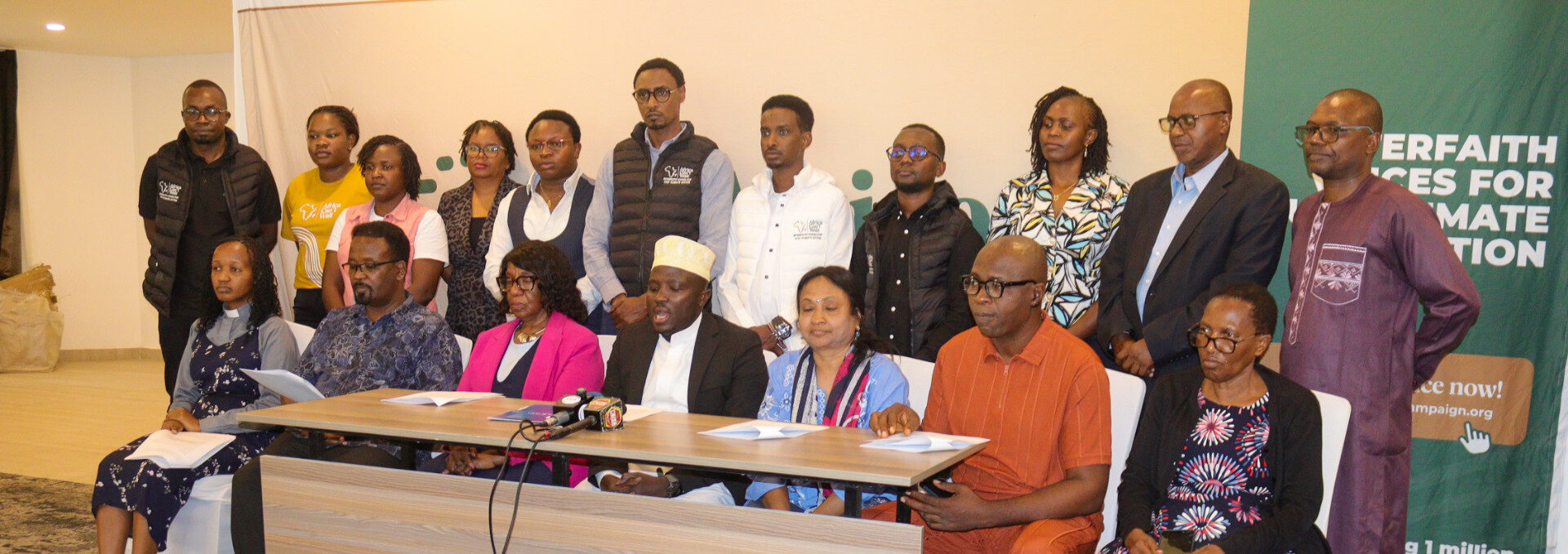
We, faith leaders and representatives of diverse religious traditions, faith-based organisations, women, youth and community networks from across Africa, gathered in Nairobi to prepare for the upcoming United Nations Climate Talks(COP31) under the auspices of the Africa Can’t Wait Campaign, and inspired by the conviction that implementation of climate action must be just; affirm that a shift From Climate Pledges to. real action is urgent and must be deliberate.
Over one and a half day days of dialogue, learning and reflection, we assessed the state of climate action in Africa, examined the realities facing frontline communities, and explored how faith communities can contribute to accelerating implementation, accountability and justice in COP 31 and beyond towards COP 32
The convening reaffirmed a shared conviction that the climate crisis is both an environmental, moral and structural challenge. Across Africa, communities continue to experience devastating droughts, floods, displacement, food insecurity, biodiversity loss and loss of livelihoods. Yet those suffering the greatest impacts are often those who have contributed least to the crisis. A response to these realities requires bold action as the welfare of people and the earth stands at risk.
Africa cannot afford another cycle of promises without implementation. The success of COP31 must be measured by tangible decisions that drive improvements in the lives of people and communities most affected by climate change. The true legacy of COP31 will be whether it delivers real change for vulnerable communities, strengthens resilience, and advances climate justice for Africa and the world.
On Adaptation:
Faith leaders, actors and the interfaith coalition agrees that adaptation is a central priority for the African Continent. Africa’s vulnerability is compounded by its reliance on climate sensitive sectors of the economy and heightened levels of poverty.
COP 31 in Turkey should deliver a workable system for measuring adaptation progress, a credible pathway to adequate and accessible adaptation finance, and a clear implementation process that puts vulnerable communities at the centre. Without these, the global goal on adaptation risks remaining an international framework rather than a mechanism for improving people's resilience. We call for the provision of adaptation finance, and design of adaptation interventions that are locally led, and impactful to the lives of frontline communities and groups in particular women, youth and people living with disability.
On Loss and Damage:
The Faith community is deeply concerned by the possibility of shooting beyond the 1.5 degree warming target..The failure of major emitters to lead the reduction of emissions to levels that ascertain the world remains below the 1.5 degree temperature goal is driving consequential climate impacts that cause losses and damages.
We applaud the establishment of the United Nations Loss and Damage Fund and efforts to get it operational. However, we remain deeply concerned by the low levels of finance symbolizing that pledges made are minimally converted into actual financial resources. We call upon all countries that pledged to the Fund for Responding to Loss and Damage to redeem their pledges and further call upon developed countries to increase their financial contributions to the Fund. Further, increased focus on non economic losses and damages is needed as destruction of our social and cultural identity by climate change must be accounted for.
On Just transition:
Our faith compels us to care for creation and humanity. Current extractive and emission intensive pathways must shift to equitable, low carbon and resilient pathways. Such pathways must support sustainable development and create a growth benefit for Africa.
The transition to low-carbon development must create opportunities for communities rather than deepen existing inequalities that are visible in cases such as pursuit of critical minerals. It must not leave anyone behind. The climate and development debate in Africa should deliver increased levels of renewable energy, foster development of African technologies and green industrial capacity. We emphasize that Africa's energy transition goal must support adaptation, resilience and advance sustainable development while ensuring equitable access to affordable and clean energy. The faith community demands a fair and equitable opportunity for Africa in shaping and landing the transition.
On climate finance:
As a matter of principle, the faith community emphasizes that urgently required adaptation finance should not increase the debt burden of already struggling vulnerable African nations.
Debt imperils economies and it is deeply unjust if finance meant to address the climate crisis, safeguard life and livelihoods drives greater debt burden on these nations. We insist on the critical need to provide grant-based financing to African nations to address adaptation, just transition, and loss and damage needs. At COP 31, Africa must advocate for an NCQG implementation that does not shift the burden of financing climate change to African nations, and one with a fair share for adaptation, Loss and Damage finance, and direct, unconditional grant-based support to vulnerable communities. We call upon African leaders to demand the clarification of the tripling adaptation finance commitment agreed in COP 31, Brazil. Efforts to provide and mobilize climate finance by developed countries and international financial institutions must result in an overall positive growth of the African continent by supporting structural transformation, adaptation and resilience. The faith community further calls for streamlining and rationalizing access procedures that inhibit access to climate finance. It is imperative that safeguards be developed and deployed in consideration of innovative sources of finance. We further insist on the need for accountable and transparent provision and subsequent use of climate finance resources.
On Nature based Solutions:
Nature and Ecosystems Must Be Protected Through Locally Led Approaches.
The faith community, inspired by the instruction to care for creation, stands in solidarity with communities, movements and networks that safeguard ecosystem health, structure and orientation. We recognize the critical role of forests, wetlands, mangroves and other ecosystems in supporting resilience and sustaining livelihoods. Conservation and restoration efforts must respect human rights, uphold community land rights, draw upon Indigenous and local knowledge, and ensure meaningful participation by affected communities. They must be financed. We affirm that faith teachings inspire conservation, and living in harmony with nature and hereby renounce degradation and extractive practices.
In expression of our faith traditions and convictions, we commit to enhancing faith advocacy for a just implementation of climate action insisting that: 1. There should be No extraction without African value 2. No adaptation without finance 3. No transition without justice 4. No climate action when increasing Africa’s debt 5. No global climate governance without African agency 6. No more pledges without delivery