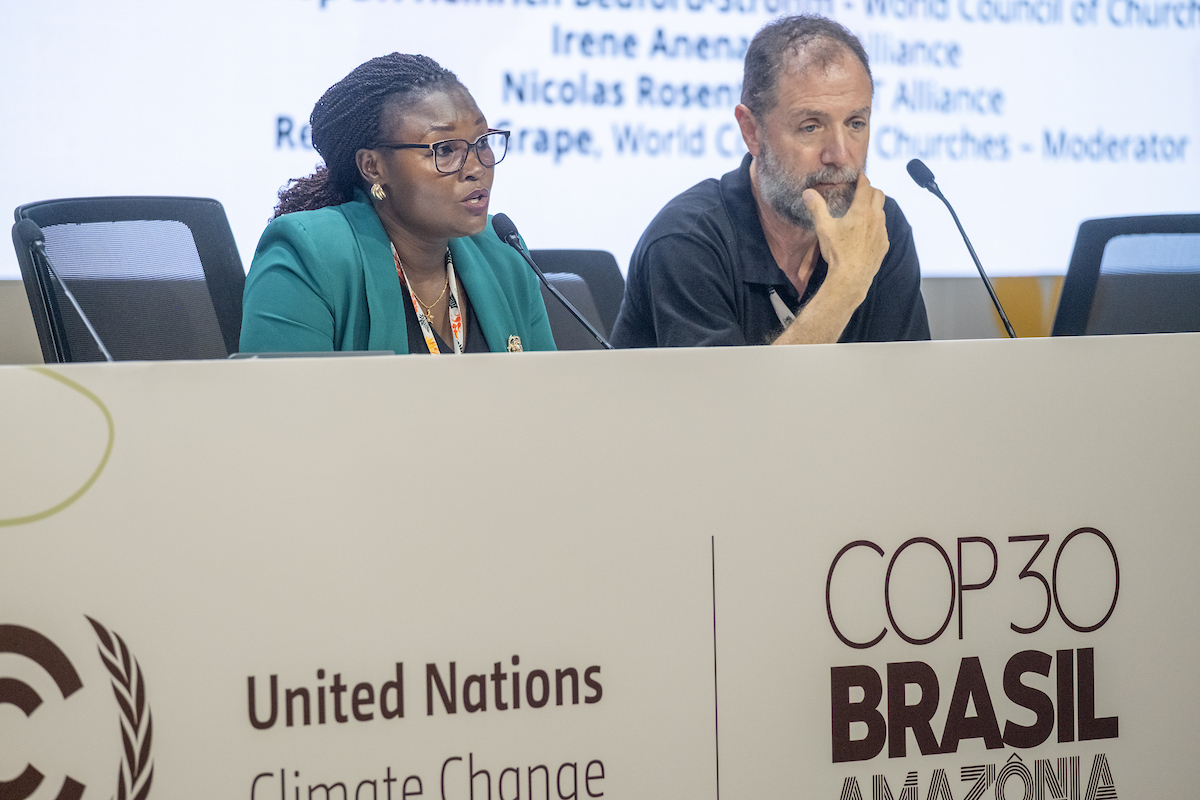
Faiths Groups to Governments at the Santa Marta Conference:
Commit to Negotiating a Fossil Fuel Treaty Now
27 April 2026, Santa Marta, Colombia: On the eve of the First Conference on Transitioning Away from Fossil Fuels in Santa Marta, Colombia, diverse religious organizations from around the world, alongside an array of Latin American faith leaders and networks, called on governments to commit to begin negotiations on a fossil fuel non-proliferation treaty. They urged people of faith around the globe to sign the multi-faith letter.
Spanning Catholic and Protestant, Buddhist, Indigenous, Muslim, Jewish, Hindu, Baha’i and other religious organizations and networks – from the local to the global – the groups called for an immediate end to new fossil fuel development, an equitable phase-out of existing coal, oil and gas production, and a fair and inclusive shift to renewable energy, leaving no worker, community, or country behind.
On 24 April, over 150 religious leaders met at the Encuentro de Espiritualidades in Santa Marta and adopted a statement, signed by 20 faith organizations, calling for a treaty and additional commitments to protect local communities across the Global South from economic and cultural exploitation and human rights violations.
Catholic Bishops’ councils from Africa, Latin America and the Caribbean, and Asia, together with representatives of the Catholic Church in Europe and Oceania, repeated the call from their March 2026 statement, Manifesto of the Churches of the Global South for our Common Home.
Faiths for a Fossil Free Future, a global, multi-faith coalition, released the names of over 700 religious organizations calling for a fossil fuel treaty and urged governments at the Santa Marta conference to commit to starting treaty negotiations.
“We are basing our demands on our shared commitment to justice for the poor, reverence for the planet, and accountability for the wealthy and powerful. Over the past five years, wars have cost over half a trillion dollars that could have been invested in education, health and renewable energy. The future must be shaped not by the logic of destruction but by a commitment to peace between peoples and with the planet.”
‘’Santa Marta is a pivotal moment in the world’s course to keep warming below 1.5 degrees, and to avert ruinous climate change impacts. It presents a key space to demonstrate leadership and commitment to a fossil fuel phase out in a fair, just and equitable manner. Governments must rise to this occasion and lead the effort. Santa Marta should strongly signal to the world the joint commitment to work out ‘the how’ to phase out and justly transition by agreeing to a principle based Treaty. We cannot afford to wait longer while the most vulnerable continue to pay the price for inaction as they face the worst impacts of climate change.’’
The religious groups called on governments gathered at the High Level Summit on 28-29 April in Santa Marta to commit to starting negotiations on a binding agreement. Four women faith leaders, elected by those attending the Santa Marta Encuentro, will represent the religious sector at the High Level Summit.
Underscoring the importance of a commitment to a treaty at the Summit, Monseñor Juan Carlos Barreto Barreto, Bishop of the Diócesis de Soacha, said, “We cannot remain indifferent when financial and economic models put human life at risk and transgress planetary limits. We are committed to promoting a just energy transition, to changing our own practices including divestment from fossil fuels, and to accompanying communities which, with their hope, sustain resistance and resilience.”
In the lead-up to the High Level Summit, the religious leaders urged countries from the Global North and South alike to commit to starting negotiations this year. “Governments must remember that our role as Khalifa, stewards of this Earth, demands more than just words,” said Nouhad Awwad, Campaigner for Ummah 4 Earth, a global Muslim climate change alliance. “For too long, fossil fuel expansion has been driven by a culture of greed that ignores the suffering of the most vulnerable. We are calling for a Fossil Fuel Non-Proliferation Treaty because a fast and fair phase-out is not just a technical necessity, but a profound moral obligation. Leaders at Santa Marta must find the political will to act.”
Faith groups around the globe will be following the progress and outcomes from the Santa Marta High Level Summit on 28-29 April, and plan to share their reactions after its conclusion.
Faiths for a Fossil Free Future is a global, multi-faith coalition calling for a fossil fuel treaty. Learn more at https://faithsforafossilfreefuture.org/.
###
Quotes for Santa Marta Multi-Faith Press Release and Social Media
“In 2023, the World Council of Churches endorsed the Fossil Fuel Non-Proliferation Treaty, recognising a hard truth: while climate action has advanced, the root cause - our dependence on fossil fuels - remains largely unchallenged. Frontline communities, least responsible, bear the greatest burden. Governments meeting in Santa Marta must act with urgency and courage, committing to negotiate a Treaty that rapidly and fairly phases out fossil fuels and ensures a just transition to equitable, sustainable energy systems.”
“The Paris Agreement is an essential framework for global climate action. However it does not name fossil fuels as the core problem or restrict their production. A Fossil Fuel Treaty can be the tool to deliver the just and equitable transition that our faiths demand.”
“Japan remains heavily reliant on coal, while public confidence in renewable energy is declining due to scandals and disinformation. Amid the current oil crisis, coal use is expected to rise making our mission more urgent than ever. We aim to mobilize more religious leaders and communities across Japan, amplify their voices to political leaders, and share accurate information through our networks and publications.”
"The moral test in front of us is whether wealthy, fossil-fuel producing countries will love their neighbours in developing and island nations such as those in the Pacific as well as the islands of the Torres Strait here in Australia and heed their call to start the process of negotiating for a treaty to phase out fossil fuels. Around the world, that is what a great many faith communities of all kinds are united in calling for."
“As we gather for the Santa Marta Conference, we must remember that our role as Khalifa-stewards of this Earth demands more than just words; it requires the courage to dismantle the systems of harm that threaten our common home. For too long, fossil fuel expansion has been driven by a culture of greed that ignores the suffering of the most vulnerable. We are calling for a Fossil Fuel Non-Proliferation Treaty because a fast and fair phase-out is not just a technical necessity, but a profound moral obligation. We must end the era of fossil fuels, stop the shift toward plastics as a 'survival strategy' for polluters, and ensure that the transition to renewable energy is rooted in justice and equity for all communities. Our faith calls us to protect life; our leaders at Santa Marta must now find the political will to do the same.”
“From the very beginning, people of faith were among the first people to call for a fossil fuel treaty. I can’t reinforce enough the importance of faith voices in this movement. The movement has grown to 120 countries, thousands of organizations representing millions of people. Faith leaders are the moral compass of the movement for a fossil fuel treaty, grounding us in justice and human dignity, calling us to courage and compassion.”
“People of faith bring a moral clarity to the need to act on the fossil fuel crisis. It is only through collective effort and solidarity that we’ll be able to bend the arc of fossil fuel supplies. The call for a treaty on fossil fuels, based on those values, is especially resonant in this time of crisis.”