With support from ACT Alliance members in Canada and USA
Since 2023, the ACT Alliance’s Locally Led Climate Fund (LLCF) has been channelling climate finance directly to communities on the frontlines of the climate crisis in Kenya, Uganda, Zimbabwe, Ethiopia, and Liberia. No billion-dollar pledges. No sprawling bureaucracy. Just approximately USD 200,000 per year, shared across four ACT Alliance national forums, each receiving an average of USD 50,000, and the conviction that the people closest to the crisis are best placed to lead the response to it.
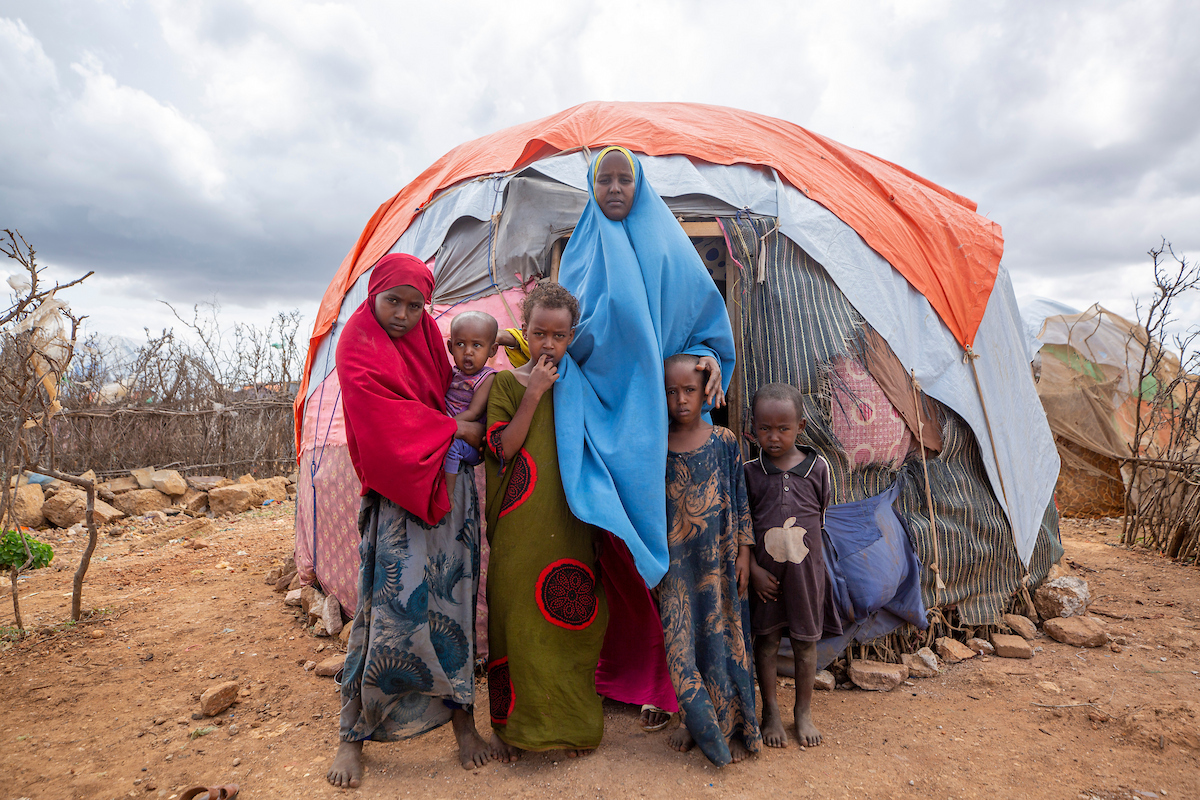
Only an estimated 10% of global climate finance reaches local communities. For the people of Turkana (Kenya), Buhera (Zimbabwe), Kasese (Uganda), and Salayea (Liberia) Districts, that failure is not a statistic. It is the dry river, the failed harvest, and the question of whether to stay on land that is changing faster than anyone can adapt. The LLCF was designed to address that gap directly.
The fund is resourced by members of the ACT Canada Forum: the World Association of Christian Communication, Alongside Hope, the United Church of Canada, Canadian Lutheran World Relief, Presbyterian World Service and Development, and World Renew. It is complemented by contributions from the Evangelical Lutheran Church in America. Together, these ACT Members pool contributions and channel them to national forums in Africa. Those forums are not merely recipients. They form the fund’s Steering Committee alongside their Canadian and American partners and the ACT Secretariat, making collective decisions on programming priorities, grant sizes, and country focus. The agency, the design, and the leadership of each intervention rests with the communities and forums closest to the work.
Now in its third programming cycle, the fund has generated three years of documented impact across five countries: in water access, food security, clean energy, climate governance, and policy advocacy. This is what locally led climate finance looks like in practice.
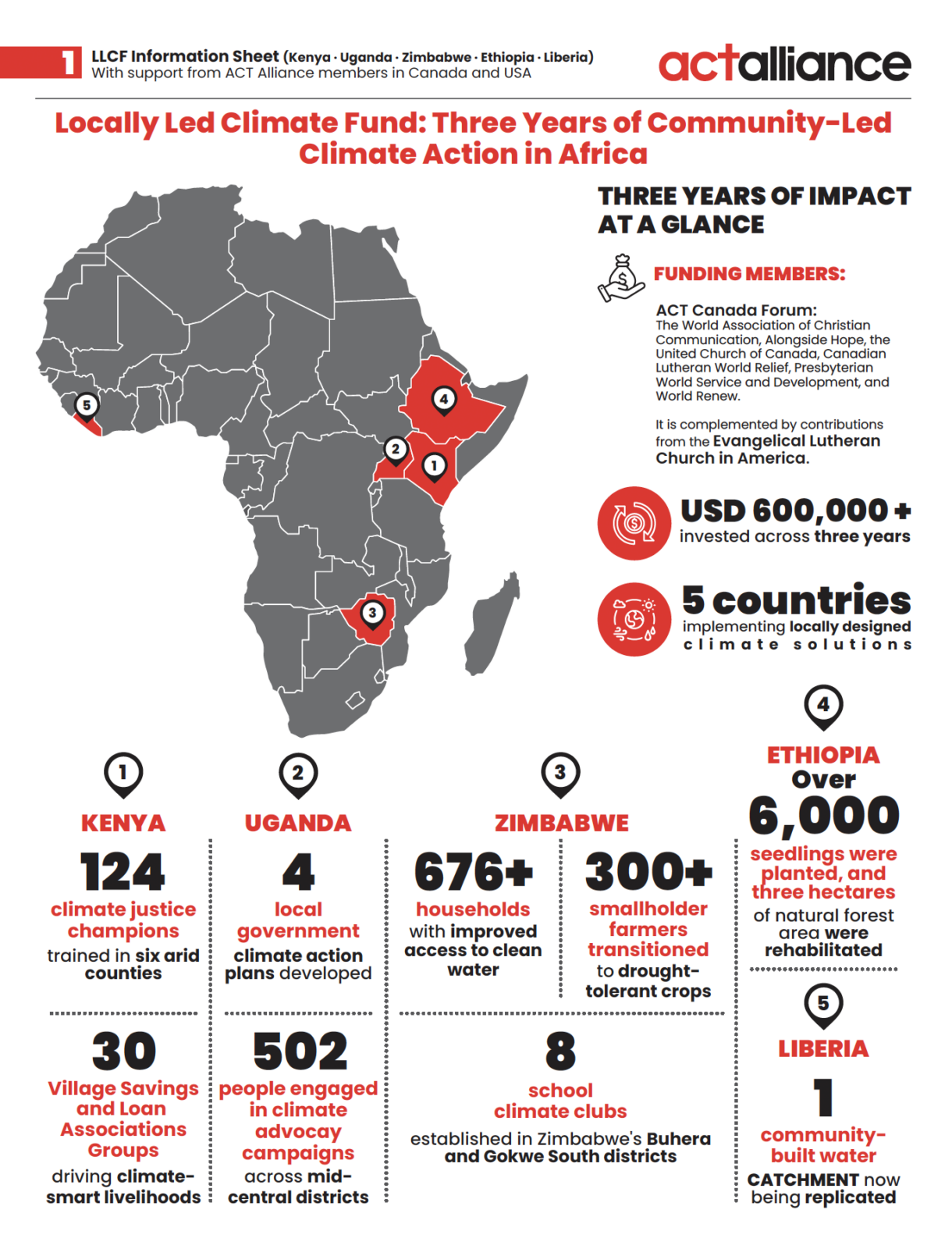
Three Years of Impact at a Glance
- USD 600,000+ invested across three years
- 5 countries implementing locally designed climate action
- 124 climate justice champions trained in Kenya’s six arid counties
- 4 local government climate action plans developed in Uganda
- 676+ households with improved access to clean water in Zimbabwe
- 1 community-built water catchment in Liberia, now being replicated
- 30 Village Savings and Loan Associations groups driving climate-smart livelihoods across Kenya
- 300+ smallholder farmers transitioned to drought-tolerant crops in Zimbabwe
- 502 people engaged in climate advocacy campaigns across Uganda’s mid-central districts
- 8 school climate clubs established in Zimbabwe’s Buhera and Gokwe South districts
- Over 6,000 seedlings were planted, and three hectares of natural forest area were rehabilitated in Ethiopia
Cycle 1 (2023 – 2024): Laying the Foundation
Kenya · Uganda · Zimbabwe · Ethiopia
The first cycle focused on building the institutional and community foundations that would carry the work forward. Working in Kenya, Uganda, Zimbabwe, and Ethiopia, the fund tested the locally led model and invested in the relationships, capacities, and early actions that made subsequent phases possible.
Kenya: The Kenya Evangelical Lutheran Church (KELC) trained 124 climate justice champions across six arid and semi-arid counties: Turkana, Garissa, Tana River, Kilifi, Elgeyo Marakwet, and West Pokot. These champions were drawn from faith communities, NGOs, and county leadership, and were equipped with skills in climate adaptation, resilience building, and advocacy. Fifteen Village Savings and Loan Associations (VSLA) were formed in Tana River, Kilifi, and Turkana, actively engaging farmers in tree replanting, agroforestry, and climate-smart agriculture. County environmental committees were revitalised, establishing structured engagement between community members and county environmental officers on issues including deforestation and pollution.
Uganda: RACOBAO engaged 20 Members of Parliament and civil society stakeholders on the operationalisation of Uganda’s National Climate Change Act 2021 and pushed for increased climate finance for adaptation. Eight sub-counties completed the reconstitution of dormant climate change committees, which began guiding local government councils on budgeting priorities for climate action. Advocacy campaigns across 8 sub-counties in three mid-central districts reached 502 people, supported by 2,000 information and communication materials produced in local languages.
Zimbabwe: MeDRA trained 206 faith leaders and community members on environmental advocacy and climate change, in collaboration with the Environmental Management Authority, Forestry Commission, and rural district councils. Eight community climate adaptation and policy dialogues were convened in Buhera, reaching 280 participants. Borehole rehabilitation provided clean water to 256 households in Buhera and 420 households in Gokwe South. Two nutrition gardens were established, benefiting 101 participants, 75 of them women. An afforestation initiative raised 600 tree seedlings, established a woodlot of 100 gum trees, and distributed 250 fruit trees to homesteads. Indigenous Knowledge Systems were documented in a comprehensive publication for community use.
Ethiopia: EOC-DICAC delivered livelihood diversification through poultry raising, beekeeping, and vegetable production in Gulele sub-city, training 76 urban and peri-urban community members. Over 6,000 seedlings were planted and three hectares of natural forest area were rehabilitated.
Cycle 2 (2024 – 2025): Growing the Evidence
Kenya · Uganda · Zimbabwe · Liberia
The second cycle deepened programming in three of the original countries and expanded the fund westward into Liberia, marking ACT Alliance’s first engagement in West Africa under the LLCF. This phase generated the fund’s most concrete and measurable results to date.
Zimbabwe: Two solar-powered piped water systems were installed to support two one-hectare nutrition gardens in Buhera and Gokwe South, now functioning as Village Business Units. Sales from produce in Buhera exceeded USD 1,500, contributing to school fees, household groceries, and latrine construction. Over 300 smallholder farmers transitioned to drought-tolerant crops including small grains, millet, sorghum, and short-season maize varieties, reducing crop failure rates to below 7% and increasing harvest yields two to three times per hectare compared to traditional maize varieties. Eight school climate clubs were established across four schools in Buhera and four in Gokwe South, with climate topics integrated into the school curriculum and monthly clean-up campaigns underway. Two vital wetlands were fenced and brought under community protection in collaboration with the Environment Management Agency and the Forestry Commission. Ward-based Disaster Risk Reduction Committees and Environmental Sub-Committees were reactivated and trained in hazard anticipation, resource mobilisation, and risk communication. Faith leaders trained in Cycle 1 facilitated environmental advocacy sessions that inspired immediate community action to preserve existing forests, with village heads now enforcing environmental bylaws at the local level.
Uganda: RACOBAO supported four local governments (Sembabule, Kasese, Kitgum, and Mbale) in developing climate action plans, with all four districts pledging to capture plan activities in their budgets for the 2026/2027 fiscal year. Faith leaders worked directly alongside district leaders throughout the planning process. Two women’s community groups, the Nakalago Twegate Women’s Group in Lwengo District and the Katoogo Goodlife CBS Powesa Group in Lyantonde District, were trained as community climate activists, adopting eco-stoves and accessing solar equipment through low-interest loans. The groups’ 61 members (45 women and 16 men) now serve as demonstration models for clean cooking in their communities. RACOBAO engaged 20 members of parliament from the Parliamentary Climate Change Committee in the chambers of Parliament, advocating for local government climate budget allocations and the scaling up of adaptation action. The forum was awarded a one-year grant from the Global Environment Facility’s Small Grants Programme for biodiversity conservation in the Elgon region, a direct result of increased advocacy visibility under the LLCF. Climate finance dialogue meetings with ministries and government agencies documented a concerning decline in Uganda’s climate finance commitments, from USD 447.40 million in 2021 to USD 272.6 million in 2023, providing an evidence base for continued advocacy.
Kenya: 90 climate justice champions were actively engaged in community advocacy and resilience building across the six target counties. In Turkana, VSLA groups increased maize yields from the usual 2 bags per acre to 17 bags of 90kg per acre, and expanded the acreage under production from 2 acres to 6 acres. In Tana River and Kilifi, registered VSLA groups engaged with local farmers to replant lost fruit trees, with over 300 farmers expressing interest in improved seedlings. In Dadaab, refugee-led organisations transitioned from sack gardening to full-scale ground farming, cultivating beans, maize, tomatoes, and fruit trees. Two climate justice champions were selected by the West Pokot County government to join the county ward climate committee. KELC fostered partnerships with county governments, NGOs, and UN agencies, and contributed advocacy evidence toward Kenya’s Climate-Smart Agriculture Strategy.
Liberia: The Lutheran Development Service constructed a water catchment in Telemai, Salayea District, Lofa County, providing year-round irrigation for rice and vegetable production. A five-year land use agreement was secured. Twelve communities were trained on climate change impacts and mitigation strategies. Ecosystem promotion policy guidelines were developed and launched in August 2025, through consultations with communities, local authorities, and representatives from the Ministries of Agriculture and Internal Affairs, the Environmental Protection Agency, and the Forestry Development Authority. Cocoa agroforestry was introduced for landlords who provided land for the catchment, creating a 15 – 20 year income stream that ties their livelihood to the protection of the forest surrounding the site. Fish farming in rice fields was introduced using water from the catchment, providing a reliable fresh protein source for project participants and surrounding households.
The Role of Faith in Climate Action
Across all four countries, faith communities have been central to the LLCF’s results, not as a delivery channel but as the first mobilisers of community action.
In Zimbabwe, 206 faith leaders trained in climate change advocacy have translated that knowledge into congregational action. Forests are being protected. Environmental bylaws are being enforced by community leaders who first heard about climate stewardship in a church context. Faith leaders in Gokwe South are actively sharing climate information at church gatherings, contributing to measurable reductions in tree cutting.
In Uganda, the Archbishop of the Church of Uganda led a public call to action on tree planting and growing, and plastic-free churches during the 1st African Climate Summit. RACOBAO worked directly with clergy to mobilise district leaders for climate action plan development meetings, and the clergy’s presence ensured the right people came to the table. Interfaith leaders in Lwengo and Lyantonde serve as community sensitisation ambassadors on renewable energy and environmental conservation.
In Kenya, climate champions drawn from faith communities found that their faith identity gave them access and trust in conversations with pastoralists and marginalised communities that no project identification badge could provide.
This is not incidental to the LLCF model. It is one of the fund’s core differentiators. ACT Alliance’s position as a global coalition of churches and faith-based organisations, operating in over 120 countries, means that every forum it works through carries the reach, trust, and moral authority of a faith institution, a multiplier that offers strategic advantage in fair partnership building compared to other climate finance options.
ACT Alliance’s faith-based approach to climate action extends beyond the LLCF. Through the Needs-Based Advocacy on Adaptation in Africa project, ACT Alliance has been positioning faith leaders across six countries as voices in national adaptation planning processes, contributing to Uganda’s National Adaptation Plans and Kenya’s climate legislation. The LLCF and this regional advocacy work are two sides of the same commitment.
Cycle 3 (2025 – 2026): Scaling What Works
The third and current cycle is the fund’s most ambitious. Each country forum has returned with a concept that represents a significant evolution from where they began, moving from pilot to scale, from demonstration to institution, from community to policy.
Kenya: The C-RAISE project is consolidating three years of investment. Ninety climate justice champions are moving from training into active leadership, channelling community evidence into county and national policy processes. Thirty VSLA groups are being deepened as advocacy hubs. Gender and peacebuilding dialogues are being introduced for the first time, recognising that the climate crisis is not gender-neutral.
Uganda: RACOBAO is scaling clean cooking to 250 more households and training community groups to produce eco-friendly briquettes from agricultural waste. Two new District Environment and Natural Resources Committees and eight Sub-county Climate Change Committees are being formally established within government structures. Two additional local governments are being supported to develop climate action plans.
Zimbabwe: MeDRA is transforming the Kugarika Kushinga community garden into a Climate-Resilient Agribusiness Hub. The old Rambanapasi clinic building is being refurbished to house vegetable and honey processing equipment. A solarised borehole will supply reliable water to four surrounding villages. Twenty beehives are being installed at a protected wetland in partnership with Bee’s Honey Company, making wetland protection economically self-sustaining. Youth Digital Champions are being trained to disseminate Indigenous Knowledge Systems through a WhatsApp channel and to market the agricultural hub produce using digital tools.
Liberia: A second water catchment is under construction in Salayea District. Two fish ponds are being developed alongside it. The ecosystem policy guidelines launched in August 2025 are now being advanced toward formal legislation, with the District Representative in Parliament engaged as champion. Consultative engagements are underway with the Ministry of Justice, Ministry of Agriculture, Environmental Protection Agency, and Forestry Development Authority.
What the Fund Has Demonstrated
The LLCF’s argument is not made in policy briefs. It is made in the 17 bags of maize per acre harvested in Turkana where there were once 2. In the 4 climate action plans that now exist in Ugandan district offices where there were none. In the ecosystem policy guideline that started in a community meeting in Lofa County and is now heading for Parliament. In the 356 people in Ward 8, Buhera, who turn on a tap today where they once walked hours for water.
The fund has demonstrated that with accessible, predictable, locally designed climate finance, communities do not just adapt to the crisis. They build institutions. They change policy. They grow enterprises. They protect ecosystems because it is in their economic interest to do so. They support incremental gains towards real transformation.
As the LLCF moves toward Phase 4, starting in November 2026, its ambition is to become a multi-year revolving fund: predictable, expanding, and permanently rooted in the communities it serves. ACT Alliance members who share this vision are invited to join the fund. The LLCF is not a project with an end date. It is a growing coalition of faith-based organisations that seek to intentionally partner to advance local level leadership and action by putting resources where the need is greatest.
To find out how to be part of the Locally Led Climate Fund, contact the ACT Alliance Secretariat at julius.mbatia@actalliance.org.